
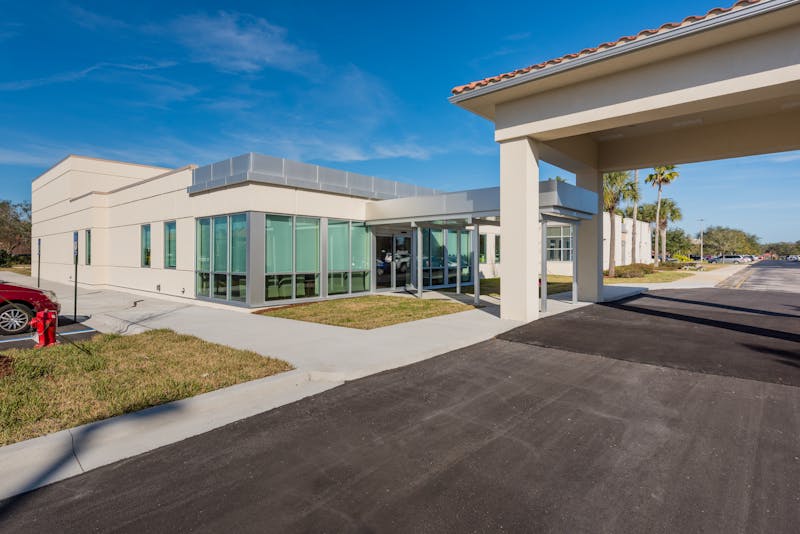
Medical technology doesn't wait for construction schedules. Next-generation equipment and shifting patient demands can make a facility obsolete before it's fully paid off. RAD Technology Medical Systems has spent more than two decades solving that problem with modular medical facilities designed to adapt as programs grow, without requiring demolition or full reconstruction every time technology advances.
Read on to see how expandable facility design works in practice, and why the building itself needs to be part of the long-term strategy.
Why Traditional Construction Limits Your Options
Conventional vaults and clinical spaces are built for permanence. That's usually the goal, until the program changes. When a cancer center upgrades its linear accelerator, the new equipment may require different shielding, a different base-frame configuration, or more vault space. For poured concrete, those adjustments require demolition and full reconstruction, with service disruption lasting weeks or months. For cancer patients in active treatment, delayed access to care has direct consequences.
The same dynamic plays out across specialties. Sterile processing departments, imaging suites, and surgical facilities all hit turning points where the original footprint no longer fits the program. In a fixed building, growth requires a full project cycle and another round of capital procurement. That cycle repeats every time technology advances or patient volumes shift.
RAD's modular facilities are engineered to be reconfigured rather than rebuilt. Each facility is assembled from engineered sections that can be modified or replaced as programs change.
Capabilities that come standard with an expandable modular facility include:
- Scalable vault capacity: Vaults can be placed side by side and shielded economically across adjacent units, scaling with program volume without duplicating infrastructure costs
- Adaptable shielding: RAD's fluid shielding technology can be reconfigured for higher beam energies or increased workloads without altering the interior or exterior footprint
- Addable clinical space: Medical oncology, imaging, pharmacy, and other specialty areas can be incorporated as programs expand
- Relocation capability: Entire facilities can be moved to new sites, giving healthcare organizations the freedom to enter new markets without the constraints of permanent construction
Speed Is Part of the Value Equation
Speed matters as much as flexibility. Modular units are built in a factory while site preparation happens simultaneously, which is how RAD cuts construction timelines by up to 50% compared to conventional building. That compression matters for revenue: the sooner a facility is operational, the sooner it generates the income that justifies the investment. At the University of California, San Diego Moores Cancer Center, a two-vault radiotherapy center went from contract signing to clinical use in under 12 months, generating approximately $12 million annually during the four years a traditional project would have required.
Financing is often the other bottleneck. Capital procurement delays can push a project back by months or years before construction even starts. RAD's operating lease structure bypasses that delay: projects move forward without upfront capital, lease payments are tax-deductible, and the building is already designed to accommodate the next technology upgrade when it arrives. For some programs, the operating lease is the difference between a project that moves forward and one that doesn't.
Build Smarter With RAD Technology Medical Systems
Healthcare moves faster than traditional construction can keep up with. RAD delivers modular facilities that can expand, upgrade, and be relocated as programs evolve, backed by over two decades of experience in radiotherapy, proton therapy, sterile processing, and specialty care. The right facility accelerates both near-term equipment upgrades and long-range program expansion. Contact RAD to start the conversation.