
When a healthcare facility needs more capacity or newer equipment, renovation is the default answer. But radiotherapy vaults and sterile processing departments are a different problem from a standard retrofit. They carry shielding requirements and equipment compatibility constraints that construction budgets rarely model accurately, and the revenue cost of a delayed reopening rarely makes it into the first proposal. A wrong call can lock your program into outdated infrastructure for decades.
RAD Technology Medical Systems has spent more than two decades helping healthcare organizations navigate this decision across the Americas and Western Europe. This blog walks through the key questions worth putting to your team before you commit.
Where Renovation Gets Expensive
The costs that surface late are the ones that matter. Shielded treatment vaults require concrete pours that lock a facility into specific equipment configurations, sometimes for the life of the building. Phased construction brings sequential shutdowns and temporary service costs that add up fast. Permitting adds time. Every week before reopening is a week of delayed revenue.
There's also a technology ceiling. Many existing facilities were designed around equipment a generation behind current standards. Retrofitting for today can still leave you with a building that has no room to evolve when the next upgrade cycle arrives.
The Checklist: Questions to Ask Before You Decide
Before committing, ask these questions to your team:
- Timeline: How long can your program sustain reduced capacity? Conventional renovation is sequential; modular construction runs concurrently with site work, cutting timelines by up to 50%.
- Technology fit: Does the existing structure support near-future equipment needs, or was it built around specifications that are already outdated?
- Capital access: Is your capital approved and in hand? RAD's operating lease bypasses the procurement process, often advancing projects by months or years.
- Disruption tolerance: Can patients and staff absorb active on-campus construction? Major medical facility renovations can stretch well beyond a year.
- Revenue impact: How much does a delayed opening cost per month? For radiotherapy centers, that figure can reach seven figures annually.
- Future flexibility: Do you expect program changes in the next decade? Modular facilities can expand or reconfigure; poured concrete cannot.
What the Modular Path Actually Delivers
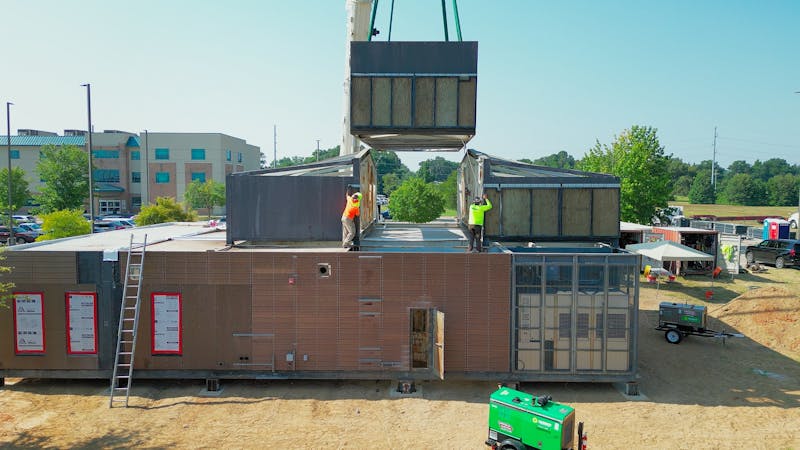
RAD's facilities meet the same local and state codes as conventional construction, with interior and exterior finishes customized to blend with existing campus structures. The difference is in delivery. Modules are built off-site while site foundations and utilities are installed simultaneously, cutting the schedule by months or more. RAD's operating lease replaces the capital budget line, letting programs open and generate revenue well ahead of where conventional procurement would put them.
Adaptability is the longer-term advantage. RAD's proprietary fluid shielding technology allows energy levels and workloads to be adjusted without altering the building footprint, meaning the facility can keep pace with equipment upgrades without structural demolition. When linear accelerators need to be swapped, RAD's steel base frame cassette handles the exchange without saw cuts.
This operational continuity was proven at Titus Regional Medical Center (TRMC) in Mt. Pleasant, Texas. When TRMC needed to upgrade the radiotherapy vault at the Patty & Bo Pilgrim Cancer Center, shutting down during construction would have forced vulnerable cancer patients to travel long distances for care. By placing a relocatable eight-module RAD Temp facility adjacent to the cancer center, assembled on-site in just two days with a pre-commissioned linear accelerator, TRMC maintained 100% treatment continuity and uncompromised patient care while modernizing its permanent vault. For many programs, preventing treatment downtime and retaining local patient volume closes the cost gap before construction is even finished.
RAD Technology Medical Systems Has Seen Every Version of This Decision
The right call depends on your program and how the revenue math holds up against a longer build. Most initial renovation proposals undercount the timeline and the revenue exposure. RAD gives you an accurate read on both, then delivers a facility that outperforms the conventional path. If you're ready to move forward with a team that has navigated every version of this challenge, contact RAD to get started.
This content is provided for informational purposes only. Project costs and timelines vary based on site conditions, program requirements, and applicable local regulations.