
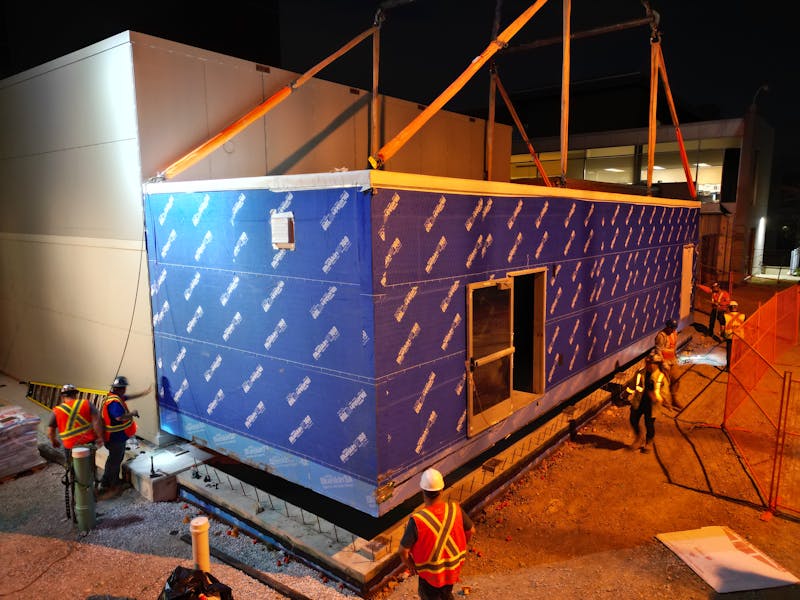
Healthcare infrastructure decisions have a long half-life. A concrete radiotherapy vault built around a specific linear accelerator locks in assumptions about beam energy and equipment configuration that can be obsolete within a few years of completion. When technology moves on, the building generally can't.
RAD Technology Medical Systems has spent more than two decades helping cancer centers and specialty healthcare practices solve this problem. Their Modular Medical Facility (MMF) approach builds adaptability into the structure from day one, so facilities can evolve as technology and programs change. This blog examines where conventional construction creates long-term risk and what modular infrastructure offers as an alternative.
The Lock-In Problem in Healthcare Construction
Traditional healthcare construction is precise by design, and that precision is the problem. Concrete vaults are engineered around the specific machines they house. When a cancer center upgrades to a newer linear accelerator, the existing structure may need saw-cutting or costly renovation just to accommodate the new equipment.
Site limitations create a separate risk. A facility built on campus a decade ago may no longer meet current patient volumes or program needs, and relocating it would mean starting over, with full capital procurement and construction timelines attached.
Built to Adapt: How Modular Design Reduces Risk
RAD's modular technology is built to handle both scenarios. Their proprietary fluid shielding technology enables adaptation to higher beam energies or increased workloads without changing the facility's footprint. The universal base frame socket, built into the floor of each vault, allows linear accelerator swaps from any manufacturer without saw-cutting or repositioning the isocenter (the central targeting point of the treatment beam).
Here's how that adaptability works across the RAD product line:
- Reconfigurable modules: Individual modules can be added or reorganized as program needs shift, without disrupting adjacent clinical spaces.
- Relocatable facilities: Entire RAD Centers can be moved to a new site for roughly half the cost of building a replacement from scratch.
- Equipment-agnostic vaults: RAD vaults accommodate any accelerator currently on the market, so clients are not locked to a single vendor as technology evolves.
- Side-by-side vault expansion: Multiple RAD vaults can be placed side by side, sharing shielding costs and supporting incremental program growth.
For healthcare systems managing facilities across multiple campuses, this flexibility extends the useful life of every building in the portfolio.
The Cost of Waiting: Construction Timelines and Lost Revenue
Capital procurement for major healthcare construction takes time, sometimes adding months or years between program approval and the first day of patient treatment. That delay has a direct cost: every month before the doors open is revenue that cannot be generated.
RAD's operating lease model eliminates the need for upfront capital and bypasses the procurement process. Projects can move forward in months rather than years. Lease payments are tax-deductible, and the model preserves capital for other priorities across the health system.
At the UCSD Moores Cancer Center, RAD delivered a two-vault radiotherapy facility in less than 12 months from contract signing. That accelerated timeline generated approximately $12 million in annual revenue that would not have been accessible under a conventional construction and procurement schedule.
Build for What's Next, with RAD Technology Medical Systems
Healthcare facilities that cannot adapt eventually become liabilities. RAD's modular approach addresses that directly, producing buildings designed from the start to evolve with your program rather than constrain it. If your organization has a construction project on the horizon, RAD's team can walk you through what a modular solution would look like. Contact RAD Technology Medical Systems to schedule a consultation.
This information is provided for educational purposes only and does not replace a consultation with a qualified healthcare expert. Outcomes, timelines, and project details vary based on facility requirements, site conditions, and applicable regulations.