
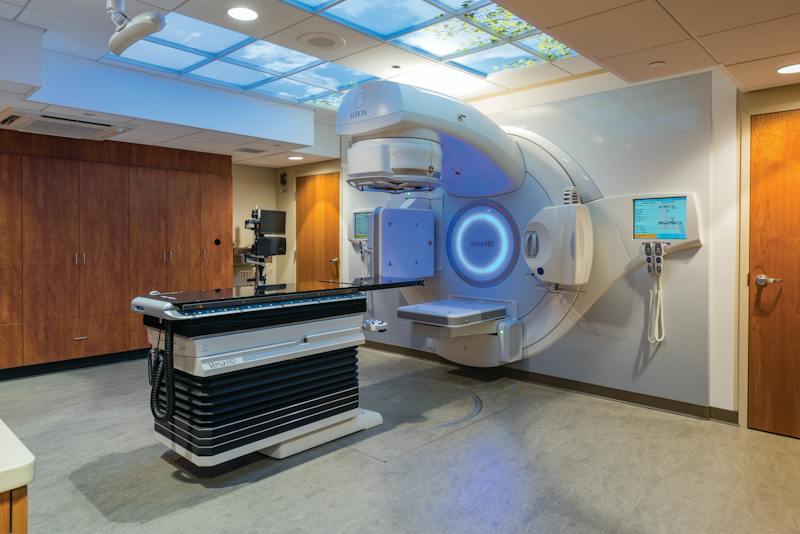
Modern linear accelerators deliver focused, high-energy beams designed to target tumors with exceptional precision. The structures housing those machines must be built to the same standard, designed for the specific equipment and energy levels inside. For decades, that meant poured concrete. The problem: concrete locks shielding specifications to a single moment, and the technology inside advances regardless. A machine upgrade or a shift to higher-energy protocols can leave a center with a vault that no longer fits its equipment.
RAD Technology Medical Systems has spent more than two decades solving that problem. The RAD Vault is a modular, shielded structure built specifically for linear accelerators, using proprietary shielding technology that adapts to higher energies as your program grows. This blog breaks down the engineering behind that shielding and what it means for cancer centers planning years ahead.
What's Inside the Shield
Conventional vault shielding works on a straightforward premise: pour enough concrete to stop the beam. That works until the beam changes. When a facility upgrades to a higher-energy machine or switches accelerator vendors, concrete walls frequently cannot accommodate the change without partial demolition and extended downtime at significant capital expense.
The RAD Vault works differently. Once the modular steel structure is assembled on site, locally sourced granular and flowable fill material is poured into engineered voids in the structural steel, forming a complete, impervious shielding envelope around the treatment room. That design produces capabilities that concrete cannot match:
- Self-healing integrity: The granular fill works in fluid communication, maintaining the shielding barrier as the material settles over time.
- Energy adaptability: RAD can increase shielding capacity for higher energies or greater workloads without altering the vault's exterior or interior footprint.
- Universal accelerator compatibility: The RAD Vault accommodates every linear accelerator currently on the market, with capacity to shield up to 18MV for linac applications.
RAD's shielding approach meets or exceeds radiation safety regulations across every market where its vaults are deployed, from the US and Canada to the UK and Western Europe.
Construction on Two Tracks
Around 80% of RAD Vault construction takes place in a controlled factory environment, well before any modules arrive on site. Foundation and utility work proceed simultaneously at the installation location, eliminating the sequential delays of conventional construction. That parallel process compresses total project timelines by up to 50%.
Modules arrive nearly complete, pre-fitted with utilities and finishes, and are assembled to a prepared foundation with minimal disruption to clinical operations. For centers with pressing capacity needs, getting a vault operational months ahead of a conventional build schedule means earlier patient access and earlier revenue generation. Over the life of a cancer program, those gains add up.
Ready for Accelerators That Don't Exist Yet
Swapping a linear accelerator in a conventional vault typically requires saw cutting through concrete and can force isocenter repositioning. Even routine equipment upgrades carry substantial downtime and cost. The RAD Vault addresses this through a proprietary universal base frame socket built into the vault floor, allowing accelerator exchanges and vendor switches without concrete cutting or isocenter changes.
When program needs grow beyond the current setup, the vault can expand with adjacent modules or be relocated to a new site entirely. For cancer centers planning a decade ahead, that kind of adaptability changes the calculus on any major infrastructure decision.
Build Forward with RAD Technology Medical Systems
With more than twenty years of modular healthcare construction, RAD has built cancer treatment infrastructure across the Americas and Western Europe. The RAD Vault is the product of that experience, designed for the long arc of accelerator technology rather than a single installation cycle. Contact the RAD team to discuss your facility's next vault project.
This content is provided for educational and informational purposes only and does not constitute professional construction or engineering advice. Project timelines, shielding specifications, and facility requirements vary based on site conditions, equipment selection, and program needs.