
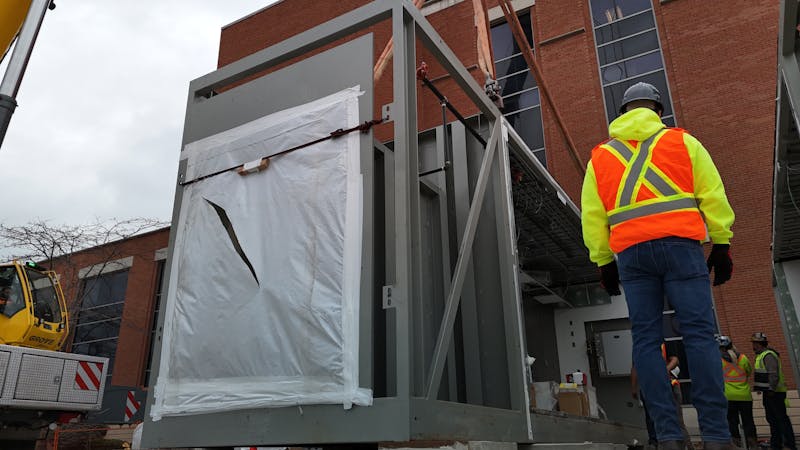
Modular buildings are gaining ground in healthcare development for one core reason: they deliver fully operational clinical space in a fraction of the time and capital required by traditional construction.
RAD Technology Medical Systems has built that case for decades, deploying patented Modular Medical Facilities (MMF) at institutions like Swedish Cancer Institute, UCSD Moores Cancer Center, and the University of Michigan Medical Center. Our work has helped hospitals open radiotherapy vaults in days and full oncology centers in weeks.
In this blog, we will discuss the forces pushing modular forward, the operational advantages it delivers, and what hospital leaders should know before their next capital project.
The Forces Driving Modular's Rise in Healthcare
Healthcare leaders are facing a perfect storm of capacity challenges. The American Hospital Association reports that hospitals are managing rising patient volumes, aging physical plants, and a tight labor market that has reshaped the construction industry. Traditional builds cannot keep pace with these demands, and modular construction is filling the gap.
Several forces are accelerating the shift:
- Aging infrastructure: Many hospital buildings sit decades past their original design life.
- Workforce shortages: The Bureau of Labor Statistics tracks ongoing skilled-trade gaps in traditional construction.
- Demand surges: Oncology, imaging, and emergency volumes keep climbing nationally.
- Capital constraints: Hospital systems want to protect cash for clinical priorities.
Speed to Operation Changes the Math
Every month a project sits in planning is a month patients wait for care, and revenue stays unrealized. Modular construction collapses that timeline by running fabrication and site preparation in parallel. RAD has installed radiotherapy vaults in as few as four days at Adventist Health Glendale and delivered 16,000 square feet of cancer center space in 115 days at UCSD.
The speed advantage shows up in several ways:
- Parallel workflows: Module fabrication runs while site work proceeds.
- Weather independence: Factory conditions remove rain and seasonal delays.
- Predictable scheduling: Controlled environments yield more accurate completion dates.
- Faster commissioning: Pre-tested systems shorten on-site validation.
Capital Efficiency Without Compromise
Capital procurement can stall a hospital project for years before construction even begins. Modular delivery, paired with operating lease structures, enables healthcare systems to open new facilities without deploying capital.
The U.S. Government Accountability Office has documented how alternative financing models help large institutional projects move faster while preserving fiscal flexibility.
Hospitals gain financial advantages through:
- Operating lease options: Capital stays free for clinical and technology investment.
- Predictable costs: Factory fabrication reduces change-order exposure.
- Faster revenue recognition: Operational facilities generate income sooner.
- Lower contingency needs: Controlled fabrication shrinks unknowns and risk reserves.
Quality and Compliance Built Into Every Module
Factory-based construction is not a shortcut around code; it is a more controlled path to meeting it. RAD builds every Modular Medical Facility (MMF) to the same standards as traditional hospital construction, with the added rigor required for transport. The Whole Building Design Guide notes that controlled fabrication environments often produce higher-quality results than field construction.
Quality benefits include:
- Code compliance: Modules meet state and local standards.
- Tighter tolerances: Factory conditions produce more precise assemblies.
- Earlier inspections: Quality checks happen before modules ship to the site.
- Transport-grade durability: Structural integrity often exceeds traditional builds.
Adaptability for the Future of Medicine
Medical technology rarely stands still. Equipment that defines best practice today may give way to something different in five years. Modular construction is engineered for that change. The Agency for Healthcare Research and Quality highlights adaptable facility design as a driver of long-term care quality and patient outcomes.
Modular facilities support change through:
- Expandability: Hospitals can attach new modules to existing buildings.
- Upgradability: Interior layouts adapt to new equipment without full demolition.
- Relocatability: Crews can move entire facilities to a different campus.
- Removability: Temporary buildings exit cleanly once permanent space opens.
Modular Healthcare Development, Backed by Decades of Proven Delivery
Modular buildings are gaining ground in healthcare development because they solve the problems hospital leaders cannot afford to ignore: time, capital, quality, and clinical continuity. RAD has been at the center of that shift for years.
Ready to see how modular construction fits your next project? Contact RAD Technology Medical Systems today to schedule a consultation with one of our modular experts and start planning your facility.